Enough with the zombies!

No, no, I have nothing at all against The Zombies. Those guys were great!

I’m done with our culture’s continued and ongoing obsession with zombies in general. And that’s hard for me to admit, because I was identified as an expert on zombies in film, even to the point of leading a discussion about the raging slow- versus fast-zombie debate.

(In short, fast zombies are essentially the same as homicidal maniacs [looking at you, Danny Boyle and your 28 Days Later/28 Weeks Later] so who cares? Slow zombies are cooler because they’re a metaphor for the end that’s heading our way regardless. And they’re the catalyst of our own stupidity, self-centeredness and fear of life. But that’s just me yakkin’… )

Back to the main point: Zombies are everywhere now, and I don’t think that’s a good thing. In fact, it’s alarming. Is this a symptom of an underlying dread we have as a society? Do we collectively imagine, or even worse, believe, some big slate-wiper event is heading towards us, one shuffling footstep at a time?

Don’t get me wrong: zombies can be great. I loved “Sean of the Dead,” “Zombieland,” and even the FAR earlier “Return of the Living Dead”. The first time I saw the original “Night of the Living Dead,” it was shown using an old 16mm projector in the back room of our town’s public library. The experience was like watching a found-footage documentary, and as I was walking to my car – the parking lot lights went out. Yes, I nearly browned myself. But I told everybody what a great movie it was. And I’ve even watched the remakes of George Romero’s works, to mixed results.

I can also appreciate zombies as both political statements and as social events. Bring the whole family!

But damn, this death-cult worship is getting old. I know a lot of us are afraid: war, terrorism, mass shootings, disease, economic disaster, famine, rising sea levels, December 21, 2012 (and anyone want to make a bet with me on that, BTW?), Armageddon, the national elections… all the old classics.

So what? Get over it, and go DO something. do something to make your life, your family, your community a little safer. Maybe even a little happier.

I was in New York City during 9/11. It was terrible. But it wasn’t the end. Not by a long shot. why are we now worshiping The End?

And of course, we always like our monsters. It helps us project our real fears and anxieties onto something outward. Something fantastic, from the dream world. Fables brought to vivid focus. But this just feels like too much.

Is it possible to have a more life-affirming Other come to knock on the door in the middle of the night? Hey, The Joker was a relentless sociopath, but at least he smiled and liked practical jokes.

Heck, even vampires resurrect and mix it up with us. Too bad the “Twilight” series reduced them to teen-dating anxiety…

Before Katniss; Other Teen Dystopia

Yes, The Hunger Games is a box-office phenomenon, and good for them!

The film’s creative team did a good job translating the book to screen (and yes, I know there are some detractors out there, but screw ’em. A film is it’s own separate work of art and has its own needs and requirements). The producers also did a fantastic  job keeping the budget down and production values high. Who can’t appreciate a film that can succeed artistically and financially, right?

But this isn’t the first teen-dystopia film. Not by a long shot. A really quick, top-of-my-head review would include Lindsay Anderson’s “If… with an incredibly young Malcolm McDowell; Michael Anderson’s “Logan’s Run with Michael York; and Stanley Kubrick’s “A Clockwork Orange, with a not-as-young Malcolm McDowell. I could go on and mention Peter Brooks’ “Lord of the Flies, and even “Children of the Corn,” but we’re getting younger and younger with these films. (And, with that last mention, crappier and crappier.)

The film I’m REALLY here to talk about is arguably the best teen-dystopia film ever made. You’ve probably never seen it, possibly never heard of it, and that’s a crying shame. It’s a disturbing, exciting and even hilarious work of genius by one of Japan’s premier directors, and he regarded it as his warning cry to younger generations.

That film is Battle Royale” by Kinji Fukasaku. It came out in 2000, never got a real US release, but it will knock you on your ass. It’s been release on Blu-Ray recently, although you can also find regular DVD versions. The story takes place in a near-future totalitarian Japan that keeps its population in line and entertained by a yearly battle to the death of an entire randomly-selected school class. The set up takes place in just minutes, and the students literally have to come out of the room fighting. Beyond that, it’s a gigantic bloody game of hide-and-seek among the adolescent characters.

I first saw the film on DVD, with my nephew. We had no idea what to expect, and our jaws dropped in awe, terror and admiration as the movie played out. At the end, he turned to me and said, “That was the best movie EVER!”, so we promptly turned around and screened it again. It’s that damn good.

Even though the film won several awards and was the buzz on the festival circuit, word was an American release wasn’t possible so soon after the 1999 Columbine massacre. It looks like an American version is in development, but that’s been a rumor with different production houses for years now.

Do yourself a favor and check out the original, on Blu-ray or regular DVD. Keep in mind this film ISN’T for young children, and it’s in Japanese with subtitles. Oh, and under no circumstances should you check out the sequel. The director died while production was under way, and the film was completed by his son. It’s not good; really not good at all.  Trust me on this.

All that said, I can’t recommend “Battle Royale” highly enough. Here’s the trailer:

Wesley Wolfe: “Only Ray of Sunshine”

First the clip, then the story (but for this one, I recommend clicking on the “Vimeo” link in the bottom right, so you can see this video in its full glory. There are a lot of moving parts…):

The song is “Only Ray of Sunshine”, from Wesley Wolfe’s Storage album (Odessa Records, 2010).

Wes is a really nice guy — soft-spoken, polite, and hard working.

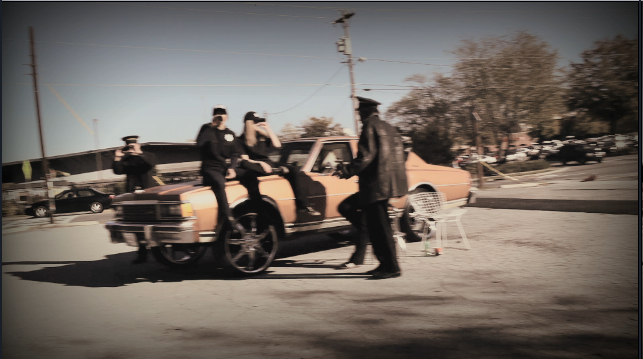
Why, exactly, would his video have a lot of bad cops doing a lot of bad things as one poor couple sat there bound (and the female, hooded)?

Because we talked him into it. Half-kidding — it started from a germ of an idea about this sweet little love song and how to shake up the visuals. Showing a couple in the park holding hands wasn’t going to cut it. The project needed the Creato Destructo Imagery edge.

“It started out as a concept about a guy tied up in a trunk being dropped off mysteriously in front of a woman already tied up — basically the action at the core of the produced video,” said director Jerry Stifelman. “Then we had a creative session with Wes, who came up with the idea of making everyone cops, based on the lyric, ‘We are all criminals disguised as cops.’  Then we all came up with having all the cops being as uncoplike as possible… I love working with an artist to bring the video even closer to the essence of the song.”

As producer, it was a great moment when we really connected with the talent on the concept. Truly, this was an idea that hasn’t been done many times over in a music video.

But also as producer, I began tugging at what hair I have left — there were so many questions:
– Where are we going to find all these people?
– How are we going to find (and pay for) the cop uniforms and accessories (badges, caps, etc.) for all these people?
– WHERE can we pull this off?
– We’re in a small town. This really has to be done in public to visually “sell” the concept. What will our REAL cops think?

The good news is Wesley is well liked, so we were able to draft a lot of his friends, fans and family. And the good folks at Odessa Records also joined in. Then, we worked our own lists of good-humored friends, and supporters of Creato Destructo, and got enough bodies to approach a visual critical mass the video scenarion needed.

In terms of the uniforms, accessories, and other things that were needed — hire us and we’ll tell you all about it. (But one thing that worked in our favor was Halloween.)

We also benefitted from the great talent at Playmakers Repertory Company and the affiliated UNC Department of Dramatic Art. Not only were we able to “seed” trained actors into the bad-cop group — we also found standout talent Kelsey Didion, who earned my undying loyalty to her acting skills by sitting there, for hours, bound and hooded on a cold and windy day. (Kelsey, I hope someday to see you win an Oscar…)

And for location, well… we’ll have to protect the names of innocent property owners.

But enough from me. What does Wesley Wolfe think about the video?

“Jerry, James and Tracy are the kind of people I love to work with. People that have the need to create, and find any way possible to do so,” Wolfe said. “They let no obstacle — especially the all-mighty one, budget, stop them. Through ingenuity and resourcefulness they have found away to put on bigtime productions with little budget…

“I feel fortunate to be a part of their collection of work. I have only heard great thing from people that have seen it. My closest friends we’re blown away by the video. The production value speaks for itself.”

So far, so good. How did he feel about the process of taking his song (a highly personal thing), and handing it over to others, to translate it into a video that wasn’t necessarily… his?

“Another thing I admire is how open and flexible Jerry was to ideas and changes in post production. He truly treated this project as a collaboration. I have no doubts that my ideas and thoughts were taken into consideration, and not just tossed to the side. Something rare in any art project,  especially when all I had to do was just show up for the shoot,” Wolfe said.

Aren’t those some production values? Damn right!  Even though I personally was still anxious on shoot day — because we had so many extras to manage — it was an amazing experience to watch as each person put on a uniform shirt, pinned on a badge, and donned headgear. They became bad cops right in front of our eyes, and it went from concept to stunning reality in just a few minutes.

The experience is well described by our own Tracey Oliveto:

“This shoot was really fun because once everyone was dressed and given their marks, it was like a big outdoor party. I couldn’t stop smiling at the image of 30 or more people dressed in uniforms, doing their thing in the sunshine and it definitely makes you stop and think about the roles we all play in life,” stated Oliveto, Creato Destructo’s associate creative director. “It was quite a spectacle and drew curious attention from passersby. Of course, James gave our Carrboro (police department), a heads up – after all,  it could have looked like some kind of conspiracy.”

Tto be honest, we had a few uneasy weeks as the local police tried to figure out if we were making fun of them, or cops in general, or if it was some kind of weird art project. This being Carrboro/Chapel Hill, it appears they settled on “weird art project” and decided not to pursue the matter any further…

All that said, the last words belong to Wolfe:

“I was nervous at first about being on camera. I really don’t like posing for pictures or seeing video of myself. They talked me into it, I trusted them fully, and I don’t regret it one bit… All in all, a great experience.”

We’ll be happy to do it again, Wes!

Wes Snaps Pic

Wesley Wolfe (left) photographs the anarchic chaos.
Sundance 2011: Documentary Roundup

First, a clip, then some comments:

The above is a backgrounder for the “Hot Coffee” documentary, more on it later.

And yes, I’m behind in terms of Sundance 2011 updates and coverage. I was surprised by some Internet access issues, but I also should have taken into account the weird day-to-day schedules that are the Sundance Film Festival.

At least I didn’t have to deal with intimate strangers in my condo, as did this journalist.

(Most of) The Winners

Documentaries are the hidden gem of the Sundance Film Festival. Sure, you get the occasional breakout hit such as “Supersize Me” or “Bowling for Columbine” — but there are a lot of other great documentaries that essentially go on to possible but unlikely theatrical distribution ; with most relegated to PBS, cable or online.

That’s a shame. The documentary programs (U.S. and World Cinema) essentially match the structure of Sundance’s feature film organization: films in competition, films that are premiers but not in competition, then other slots for those that are hard to peg or need some additional support (such as Spotlight, NEXT, Park City at Midnight, depending on the year and selections).

And it’s a shame these docs don’t get their fair share of attention. They’re generally of a far higher quality than the features, and they don’t suffer from the same tension of art-vs-commerce in terms of featuring celebrity/name actors versus just great acting talent that the fictional pieces have to balance.

Yak yak yak. Here’s a short list of docs that won awards at the 2011 festival, so they’ll likely be distributed in some form, this year:

How To Die in Oregon, directed by Peter D. Richardson. This won the Grand Jury Prize. It’s a study of how that state’s assisted-suicide rules affect the lives of terminally ill patients, their families, and the physicians involved. Gripping, ultimately affirming.

Hell and Back Again, directed by Danfung Dennis. This is a joint U.S./United Kingdom production, and won both the World Cinema Grand Jury Prize and World Cinema Cinematography Award. To the point, though, it’s about the journey of North Carolina soldier Sgt. Nathan Harris, shot by the Taliban in Afghanistan. His recovery has been long and grueling, and supposedly reveals the cost we’re paying in lives lost and lives damaged in this ongoing conflict.

Buck, directed by Cindy Meehl. This won the Documentary Audience Award, and profiles the trainer that inspired “The Horse Whisperer,” Buck Brannaman.

Project Nim, directed by James Marsh. This won the World Cinema Directing Award, and is from the same team that brought us “Man on Wire”!! Nim is a chimpanzee that, beginning in the 1970s, was taught sign language in an attempt to see if we could have true cross-species communications. Things… evolve from there.

Documentaries that need some championing

(As in, they may be harder to find after Sundance).

The Green Wave, directed by Ali Samadi Ahadi. The first major documentary about the short-lived, violently-crushed democracy movement in Iran, 2009, following what likely was an election stolen from Mir Hossein Mousavi.

The iranian director combines live action and animation to tell this heartbreaking story, while also offering up hopeful possibilities for the future.

The Last Mountain, directed by Bill Haney. It’s about the practice of mountaintop coal removal, specifically in West Virginia. But If this doc is even halfway competently done, it should ring alarm bells nationwide in terms of the short- and long-term damage this practice does to the environment, the community and the local and regional economies.

Hot Coffee,  directed by Susan Saladoff. It’s about the McDonald’s hot-coffee lawsuit, but DON’T roll your eyes. It tells the story after the story you think you know. McDonald’s and other large corporations have used this case as an example of how tort law needs to be reformed — but it’s a slick spin job on their part. Hearing how average citizens have tried to get their cases to trail could make this a crowd-pleaser.

Probably coming to your town or television…

Documentaries that, while still good, probably have a great shot at widespread distribution —

Miss Representation, directed by Jennifer Siebel Newsom. This focuses on how women are portrayed in the media, and in our culture at large. It features interviews with Katie Couric, Condoleeza Rice, Nancy Pelosi, Gloria Steinem and Rachel Maddow, to name just a few. Trust me, you’ll get a chance to see this one.

Page One: A Year Inside ‘The New York Times’, directed by Andrew Rossi. A fascinating account of how arguably the world’s best newspaper is dealing with the change from print to online — but not just in terms of delivery modes, ad charges, and balance sheets. What happens if The Paper of Record loses the economic and cultural battle, and we lose one of the great investigative reporting resources the nation has ever known. Is a replacement model even possibly in this day and age? Are essentially unedited/lightly curated online resources such as Wikileaks even near what the NYT brings to the table?

One way or the other, this will get some form of distribution.

Troubadors, directed by Morgan Neville. The story centers on James Taylor and Carole King to discuss the larger story of 1970s Los Angeles-based singer/songwriters. Could be just great, likely will get distribution, but other docs deserve more championing.

Sundance 2011: Day 5, the YouTube Connection

First, a couple clips, then some stories:

But I concede that — apart from Virginia being impossibly cute, adorable and brave — this teaser doesn’t say much about the “Life in a Day” feature. Let’s try one more:

As mentioned earlier, if you live in Ann Arbor, MI; Brookline, MA; Brooklyn; Chicago; Los Angeles; Madison, WI; Nashville; San Francisco or Seattle — you can attend a special local screening of a Sundance 2011 film.

For the rest of us, YouTube will make it possible to collectively share the world premier of the “Life in a Day” documentary as it’s screened in Park City, Utah.

All you need to do is go here, by 8pm ET, 7pm CT, 5pm PT on Thursday, Jan. 27http://www.youtube.com/user/lifeinaday

Following the screening there will also be a live Q&A with the documentary’s director, Kevin MacDonald, along with a small group of specially-invited contributors to “Live in a Day”. (Impressive stats: this project drew more than 80,000 clips, and uses 1,125 of them. I’m sure the project probably shortened the lives of about 10 editors…)

Note, though, that the film WON’T be freely available on YouTube after that (it still has a theatrical run coming up this year), although you’ll be able to see a re-broadcast 7pm on Friday, January 28, in your local time zone.

But Sundance and YouTube have worked out something else that can keep you captivated through the rest of the long winter months.

Check out The YouTube Screening Room, which is showing a total of 12 shorts from Sundance 2011, plus four “career-starting” shorts from past festivals (!), and four shorts from the Sundance Directors Lab* (*no guarantee these won’t suck…). And they’ll add more on January 27 and February 3.

Meanwhile, here’s a loving tribute to 8-bit video game heros:

Want something a little more significant from your short films?

Okay, fine, check out skaters in Kabul!

Tomorrow, on the ground in Park City.

And the Best Mockumentary of 2010 is…

First, the clip, then the story:

You might have already seen “Exit Through the Gift Shop”, the film by famed street artist/social provacateur Banksy.

For a film placed in the documentary category, it’s done well at the box office: nearly $5 million worldwide so far, which places it in the Top 40 gross of all documentaries released theatrically. (Trivia: “Farenheit 9/11”, “March of the Penguins” and “Earth” are the top performing docs. I knew you’d wonder…)

I got on the “Exit” tangent because I mentioned to a friend recently that I’d hoped to be blown away by “The Philosopher Kings” — but wasn’t.

They followed with “Hey, you know what’s a great documentary? ‘Exit Through the Gift Shop’. That was a great documentary.”

After I stopped pulling out my hair, I mustered a “You really thought that was a straight-up doc?”, and got just a quizzical look in return.

— Don’t get me wrong. If you haven’t seen this film, definitely check it out. It’s incredibly entertaining. But while the filmmakers themselves will be loathe to ever tell the whole and full story about how it was made, I’ll bet everything in my 401(k) that it ain’t what many believe it to be: a real documentary.

It IS a fascinating look at the history of street art (think Banksy, of course, but also Shepard Fairey, Space Invader and Zevs, to name a few); Andy Warhol and his continued influence on contemporary art and contemporary society; and then, essentially a one-sided pissing match between the street-art community and contemporary, famous and well-paid “established” artists. Guess who comes out on top?

Oh, and this fight is cleverly wrapped inside another “fight” between alleged original director
“Thierry Guetta” and Banksy himself — who claims he had to take the project over because of “Guetta’s” incompetence as a filmmaker. Incompetence like this, which I challenge you to match yourselves:

Anyway, Banksy says you can, at home, in a couple hours or so. and that’s why he took over the project.

But let’s move on to the REAL controversy.

— Will “Exit Through the Gift Shop” get nominated in the Best Documentary category at this year’s Oscars? (It’s on the short list of 15 docs, although only 5 will make the final selection…)

— If it does, is that like Milli Vanilli getting nominated for and winning a Grammy? Okay, assume Fab Morvan and Rob Pilatus actually were self-aware and in control of their careers, if you wanted to make it a better comparison.

— What if it actually wins the Oscar for Best Doc? (“Waiting for ‘Superman'” will take it, although “Client 9: The Rise and Fall of Eliot Spencer”, “Inside Job” and “Restrepro” are better, but far more political and therefore problematic.)

Oh, and just so you know, “Exit” was nominated for the 2010 International Documentary Association’s “Distinguished Feature” award (it lost to “Waste Land”), and is also up for the “Independent Spirit Award” sponsored by IFC.

It could win (the event is Feb. 26), but if I were Banksy, I’d keep a wide berth from Sebastian Junger if “Restrepro” loses to him. Something about all that time spent at a forward operation base in Afghanistan, real bullets, real death, etc…

Sundance 2011 comes to you Jan. 27 (possibly)*

Get ready for the hype overload that will be the 2011 Sundance Film Festival. It officially kicks off Thursday, Jan. 20, opens for business Friday, Jan. 21 and continues for 10 days, with winners announced Saturday, Jan. 29.

Between now and the first of February, it will be hard to get away from the media coverage. That said, here’s a discussion by actress Vera Farmiga, who’s starring in “Higher Ground,” a film in the U.S. Dramatic Competition produced by my friend and indie film legend, Gill Holland:

To see this particular film during the next two weeks, though, you have to be in Park City, Utah.

— But don’t despair if you don’t have an incredibly overpriced hotel room booked for the gala.

*If you live in Ann Arbor, MI; Brookline, MA; Brooklyn; Chicago; Los Angeles; Madison, WI; Nashville; San Francisco or Seattle — the Sundance 2011 festival comes to you.

For one day, Thursday, Jan. 27th. And at specific arthouse venues.

This is the second year Sundance has managed this event, and its intent is to promote the Institute, the individual films and filmmakers, and the independent, arthouse theaters where the screenings are held.

And Park City will be directly involved: the “Life In A Day” documentary that kicked off on YouTube this summer — inviting submissions for ordinary people to record what was happening on July 24 around the globe — will be shown there as part of the connected, nationwide experience.

“A major component of the Sundance Institute mission is to expand and engage audiences for independent storytelling,” Keri Putnam, Sundance Institute Executive Director, said. “Sundance Film Festival USA is an extension of the Institute’s year-round support of independent theaters across the country – designed both to provide people with access to films premiering at the Festival, and to encourage interaction between artists and audiences.”

Oh, and the Sundance Channel might possibly provide some information about what’s going on during the festival. Plus CNN, MSNBC, Fox, USA Today, the New York Times, etc etc etc. And let’s not forget US Weekly.

To an unsentimental new year!

This isn’t what you think — I’m not trying to be deliberately provocative just for the sake of it.

And in fact, I celebrated Christmas with a big collection of family (I have a HUGE family, so it’s possible to fill a house and have plenty left over, unaccounted for, probably wandering around in the snow lost and abandoned. Not that I would ever do that.)

I also had a great, reasonably low-key New Year’s Eve with my “other” family and a group of interesting, engaging friends. So I can lay down the sentimentality.

During Christmas, though, I broke up the spaces between family events by re-reading Dubliners by James Joyce.

— Scoff if you want, claim that a dead white Irish male writer isn’t relevant to modern multicultural society, note that a collection of short stories first published almost 100 years ago might not stand up that well.

All I know is this:

Dubliners kicked me in the head. With no fanfare, it was an unsentimental wake-up that was a perfect antidote, to me, for what had been a heavily commercialized holiday.

I first read this in college. That event was pretty much lost on me, since it was an assignment rather than an exploration. I picked it up again in my early 30s, but I had to put it down because I was still dealing with my father’s recent death and some of the stories hit too close to home.

More recently, a co-worker lent me a copy of “The Dead”, the novella that closes Dubliners (and which John Huston made into a film, along with his son, Tony, and daughter, Angelica).  That same co-worker, Patrick, believes the final paragraph of “The Dead” is one of the most astounding pieces of English literature, period. Personally, I believe it’s great, but give the edge to the closing of The Great Gatsby.

So for about a year, I’ve been primed to take on Dubliners as an adult. I just wasn’t expecting its bleak AND beautiful nature.

My point? I’ve unexpectedly found inspiration from a great artist, reaching out from a different world and a different century. I’m going to use that inspiration this new year to better attempt looking at things as they are, not as I want (or hope) them to be.

And then moving on from there.

“One True Thing” – the documentary starts

First, the clip, then the story:

There are a lot of projects on my short list, but it’s the usual excuses of too long a list, and not enough money or time.

But excuses just don’t cut it anymore, so my plan to get this documentary project going is to just do it — and structure the plan in such a way that all the shooting can be done on incredibly flexible schedules, and the budget can remain miniscule (for now, at least).

So here’s “One True Thing”.  The idea is that our team sits down with someone at their preferred location, and once everything’s set up, all we do is ask for your first name, and to tell us one true thing.

It can be anything, from trivial to profound. So long as it’s true to you.

We also have some ground rules for ourselves/the project:

— First name only

— We won’t edit your response once you start on your true thing. That means once you being, we’ll run until you stop. So, no edits to make you look better, worse, or more concise.

— You can have more than one thing to say. We’ll just treat them separately.

— Don’t pressure yourself. We don’t expect Dalai Lama-league answers, so no worries. Something about your cat is acceptable…

What do WE get out of all this? Good question.

Expectations:

Sure, the first clip is three guys of various ages working in various levels of seriousness.

The real payoff should be when we reach a certain critical mass and broader themes emerge. Personally, I fully expect this to start focusing on religion, relationships and philosophy — but I could be completely wrong.

Maybe folks hone in on sports and cosmology, who knows?

If I were to point to an existing model for how I expect this to turn out, I’m going to reference one of my all-time favorite books and life guides: Directing the Film: Film Directors on Their Art, edited by Eric Sherman.

Yes, you’ll find a lot of practical advice on nearly every aspect of filmmaking by some of the greatest in the field — but that’s essentially a bonus.

What I find great is that within Sherman’s 352 pages of collected wisdom, you can read one absolutely sterling, profound and compelling piece of advice put forth by an absolute master of their craft — and on the next page, there’s another absolutely sterling, profound, and compelling piece of advice from yet ANOTHER master, completely and absolutely contradicting the first.

Example: Think about rehearsing your actors. There are a number of directors that weigh in on how their actors must be absolutely well rehearsed and prepared, so there’s no doubt about the lines, nuances or inflections before the cameras roll.

And there are a number of directors that talk about why anything beyond nominal rehearsal kills the energy and dampens the creative sparks from fresh discovery.

Who’s right? They all are. And that’s the point — the truths within this book are the truths that work for each person.

So that’s where I personally see “One True Thing”‘s potential. But we’ll see.

Technical Points:

As we add in clips, we’ll update the master video, and keep individual clips for easy reference.

We’re also COMPLETELY OPEN AND ENCOURAGING of outside submissions. So feel free to crank up your webcam or video recorder, work up a segment, and send it on.

Contact me at OneTrueThingDocumentary@gmail.com, or visit the project site at OneTrueThingDocumentary.com .

And of course, a special shout-out of thanks to my Creato Destructo compatriots, Jerry and Shay Stifelman. (Tracey, let’s get you taped!)

– James

“Working Women/Lazy Demons” video, redux

I’d posted a link to this music video a while back, along with a brief story about the team behind it (Creato-Destructo Imagery, which is rolling with a number of projects).

Given the nature of the video’s “story”, we’ve received some interesting and thought-provoking feedback over the last few weeks. (Full disclosure, I officially served as the 1st AD on this, although everyone performed multiple duties — driving, to animal-wrangling, to prop mastery, to traffic coordination; among a few of the more interesting tasks).

To add some perspective,  I got the director, Jerry Stifelman, to reveal some of his thoughts and artistic insights:

“‘Working Women/Lazy Demons’ is a catchy, bouncy song with a dark side. It is an ode to working woman, yet it’s also an insight into the singer’s dark side. It’s almost like he’s a vampire, sucking energy from working women to enable his torpor.

“We came up with the idea of the protagonist (who we named ‘Cal’ in honor of James Dean’s character in ‘East of Eden’) living inside his car and watching the world at a distance as a way to symbolize this. So on one side, the video depicts working women, yet always from the at-a-distance perspective of Cal.

“To cut against the upbeat theatricality of the song, we kept the imagery very naturalistic and documentary-feeling — while still doing things with slow-motion and camera angles to idealize the women, since we’re seeing them from Cal’s perspective. Unlike pop songs, films work best when there is some type of narrative arc, so we decided to bring the video to a resolution, when Cal actually breaks his lazy bubble and engages the worker at the gas station.

“To keep the ending from being too sentimental, we kept this shot very wide. This shot breaks from the rest of the video, which either focuses solely on Cal or sees via his perspective. The last shot is the film equivalent of breaking into third-person narration. Personally, to me the song has always felt a bit like one of those songs that used to open 70’s TV shows like ‘Mary Tyler Moore’, the freeze frame montage was a nod to those shows, which used freeze frames to celebrate characters.”

And of course, best wishes to Randy Bickford and Wyley Pamplin of The Strugglers, and hopes for much great musical and artistic success!