Pondering “The Philosopher Kings”

First, the clip, then the story:

This is directed by Patrick Chen, produced by Chen and Greg Bennick.

If you work in higher education, you should take the time to watch “The Philosopher Kings” documentary. It’s available on iTunes and Netflix (streaming and DVD). Consider it a homework assignment, or a continuing-education requirement.

For those not in the sector, I’m somewhat torn about recommending this documentary, which focuses on the lives of janitors and custodians at a handful of prestigeous, well known universities — including Caltech, Cornell University, Duke University, Princeton University and U.C. Berkeley, to name most of them.

I was led to this doc by a friend who knew about the Duke University connection: one of the people profiled is Oscar Dantzler, who takes care of Duke Chapel itself.

Don’t get me wrong — it’s certainly well shot (in fact, some of the visuals are absolutely gorgeous), has a fantastic music score,  is well edited, and the people featured have interesting life stories (but of course; otherwise, they wouldn’t have made the final cut).

In my opinion, while “The Philosopher Kings” is a good documentary — it simply isn’t a GREAT documentary.

And that’s problematic.

“The Philosopher Kings” was initially pitched to me as a story about these custodians/janitors, who worked at these great colleges and universities — and described what THEY learned while at work.

The documentary barely touches on that theme before pulling back and showing the real story, which is the disconnect between these people who are seen every day by faculty, staff and students — but aren’t really seen by them at all.

Where this project falls short is its nearly complete lack of interviews with some of these same faculty, staff and students, to find out what they know, if anything, about the lives of those also in service to the institution, and whose daily efforts make the offices, restrooms, lecture halls and labs habitable and useable.

In fact, if it weren’t for a sound bite delivered by former President Bill Clinton, who spoke at Duke University about this exact subject — but as part of a speech a different focus — there may not have been such a concise summary of this theme of seen but not really seen.

The exploration of the lives of the subjects is astounding. Most all of them have heartbreak in their past, and seem to have conquered that as they sought out normal lives.

It also seemed readily apparent that few if any people at these universities knew anything about these personal struggles and triumphs. Maybe that’s appropriate to a point — work is work, personal is personal, right?

But a university, a college, a place of higher learning is supposed to be about sharing ideas and experiences, building on knowledge from the past and the present, and moving society into the future with this foundation.

In a way, though, I want to promote “The Philosopher Kings” because it actively (and perhaps unknowingly) demonstrates a theme that I’ve been promoting for years. (And yes, I’ve worked in the higher education sector for a number of years, so I’m not simply shouting from the bleachers here).

Most colleges and universities are loaded with great stories, generated by their own people — faculty, staff, students, alumni and local residents.

And most colleges and universities do a poor job of identifying all but the most obvious stories (superstar faculty, high-achieving students, successful/famous alum) and getting these great stories out into the world.

Technological restrictions have fallen. True, budgetary constraints in this economy may be real factors.

But the limitations of imagination, the focus on how things have traditionally been done, and the will to move past categories, class and caste designations seem to be very real, if usually unspoken, barriers.

And it doesn’t require a philosopher king to realize that’s a shame.
“One True Thing” – the documentary starts

First, the clip, then the story:

There are a lot of projects on my short list, but it’s the usual excuses of too long a list, and not enough money or time.

But excuses just don’t cut it anymore, so my plan to get this documentary project going is to just do it — and structure the plan in such a way that all the shooting can be done on incredibly flexible schedules, and the budget can remain miniscule (for now, at least).

So here’s “One True Thing”.  The idea is that our team sits down with someone at their preferred location, and once everything’s set up, all we do is ask for your first name, and to tell us one true thing.

It can be anything, from trivial to profound. So long as it’s true to you.

We also have some ground rules for ourselves/the project:

— First name only

— We won’t edit your response once you start on your true thing. That means once you being, we’ll run until you stop. So, no edits to make you look better, worse, or more concise.

— You can have more than one thing to say. We’ll just treat them separately.

— Don’t pressure yourself. We don’t expect Dalai Lama-league answers, so no worries. Something about your cat is acceptable…

What do WE get out of all this? Good question.

Expectations:

Sure, the first clip is three guys of various ages working in various levels of seriousness.

The real payoff should be when we reach a certain critical mass and broader themes emerge. Personally, I fully expect this to start focusing on religion, relationships and philosophy — but I could be completely wrong.

Maybe folks hone in on sports and cosmology, who knows?

If I were to point to an existing model for how I expect this to turn out, I’m going to reference one of my all-time favorite books and life guides: Directing the Film: Film Directors on Their Art, edited by Eric Sherman.

Yes, you’ll find a lot of practical advice on nearly every aspect of filmmaking by some of the greatest in the field — but that’s essentially a bonus.

What I find great is that within Sherman’s 352 pages of collected wisdom, you can read one absolutely sterling, profound and compelling piece of advice put forth by an absolute master of their craft — and on the next page, there’s another absolutely sterling, profound, and compelling piece of advice from yet ANOTHER master, completely and absolutely contradicting the first.

Example: Think about rehearsing your actors. There are a number of directors that weigh in on how their actors must be absolutely well rehearsed and prepared, so there’s no doubt about the lines, nuances or inflections before the cameras roll.

And there are a number of directors that talk about why anything beyond nominal rehearsal kills the energy and dampens the creative sparks from fresh discovery.

Who’s right? They all are. And that’s the point — the truths within this book are the truths that work for each person.

So that’s where I personally see “One True Thing”‘s potential. But we’ll see.

Technical Points:

As we add in clips, we’ll update the master video, and keep individual clips for easy reference.

We’re also COMPLETELY OPEN AND ENCOURAGING of outside submissions. So feel free to crank up your webcam or video recorder, work up a segment, and send it on.

Contact me at OneTrueThingDocumentary@gmail.com, or visit the project site at OneTrueThingDocumentary.com .

And of course, a special shout-out of thanks to my Creato Destructo compatriots, Jerry and Shay Stifelman. (Tracey, let’s get you taped!)

– James

It’s an HD World

Had a new studio shoot this week — as in, a new studio space and a new project.

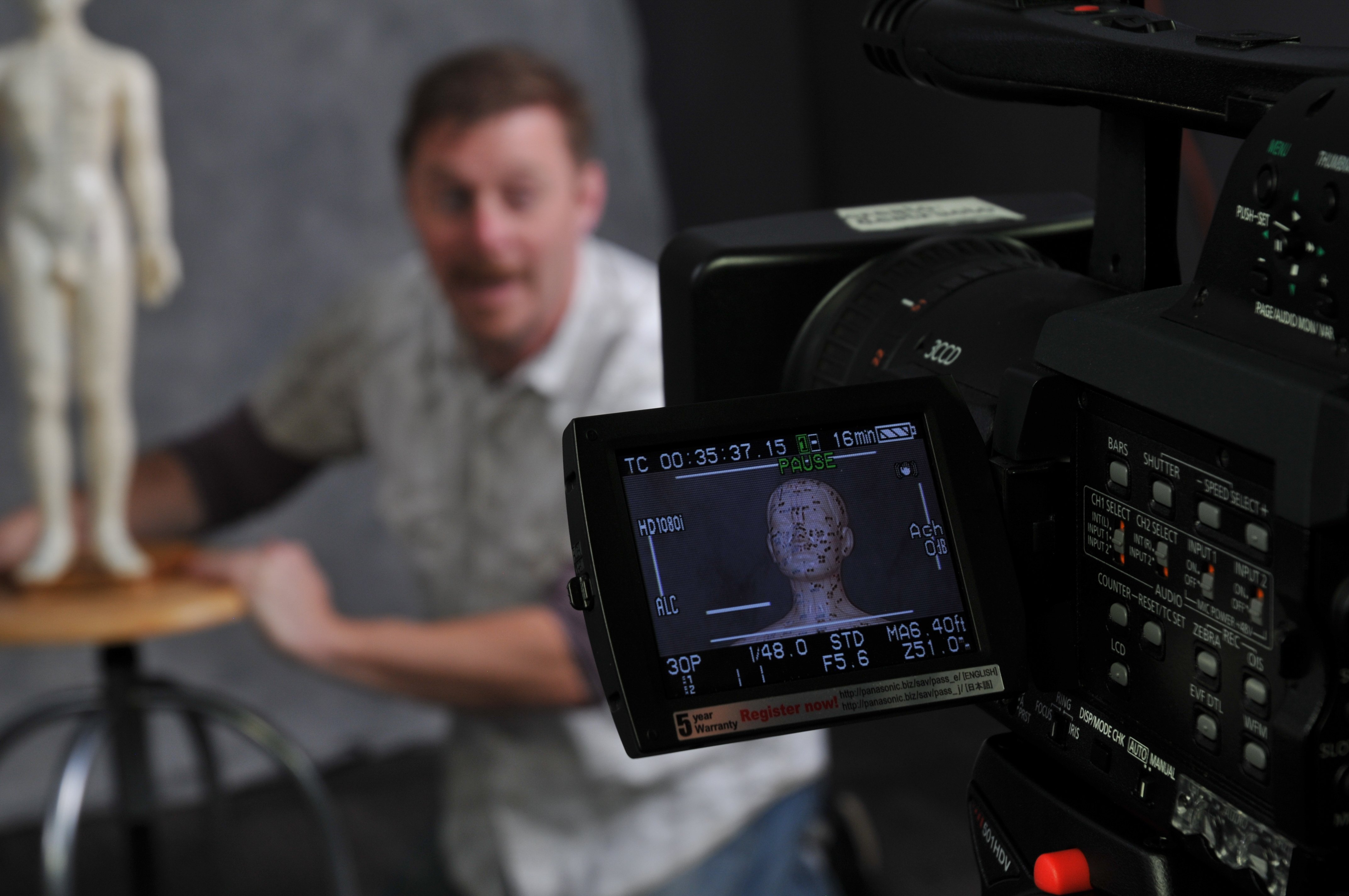
Viewfinder view

The clients didn’t have a huge budget, but recognized the need for video, and they were willing to move around some priorities to make sure this was done in high definition.

I’m amazed that some groups still ask for or even REQUIRE  480-based origination video. There are a lot of ways to shoot in HD as your source and downconvert from there if necessary. Even if you need a final 4:3 product. Even if this is “just for the web”. Even if you’re not sure how the project will evolve.

If you think your project can’t be done on HD… seriously, we need to talk.

James Hyatt

Fin.

Epic Video, Underground Band & Lessons Learned: Part 1, Reasons Why

First the video, then the story. (You may want to grab a beer first; this is 11 minutes long):

The name of the band is Shit Horse. Two words.

Yes, that’s basically a no-go at most American radio stations. Yes, it’s harder to advertise gigs or be listed in event directories. Yes, it’ll difficult to have CDs in stores (Wal-Mart, I’m looking at you…).

For Shit Horse, though, that’s missing the point. More precisely — that’s EXACTLY the point.

Background:
They came together… not as a joke, more like a conspiracy.

Part of the formation was planned: the first members came together to play the XX Merge fest in 2009.

Part was purely accidental, possibly even a twist of fate: because someone else was sick, the first three members grabbed lead vocalist Danny Magic, pretty much off the street*. (*Possibly apocryphal)

Their first release is cassette-only, in June 2010. Let me make this clear: not June 1990. Cassette only, 2010. The band held to a strict “no digital” discipline all the way through the recording process, staying analog as long and as far as possible.

The first run of cassettes sold out, and they’re spooling a new batch. But many of their fans are overseas (Shit Horse is huge in the UK; check out the mania here, and Culture Deluxe’s postings; and some proof BBC Radio 6 likes them), and shipping individual tapes is both a time-consuming pain and relatively expensive. So the band and their label, Odessa Records, have relented and produced a digital album download — primarily to make it easier for non-US fans to get their music.

Hype Factor:
The real question is: Are they the real thing?

Yes.

And like most real, authentic things, they’re far from perfect. Half their live shows are so great I’d swear we were witnessing the rebirth of rock, blues, soul, funk, punk and maybe a little jazz — all at once. They’ve made me wonder if this is the start of a new-millennial return to Americana music, with a fully aware, multi-racial, and multi-generational  group (members are in their 20s, 30s, 40s and 50s) .

During those shows, I get my hopes up and think: the Delta blues were the call. The Rolling Stones were the response. Is it possible these guys are the fully realized testimony?

But then other shows can end with at least one band member storming offstage, swearing he’s gone for good. And if you’re in the audience, holding some hope in your heart, there’s a bitter tang of disappointment, as the band plays the soundtrack to every major letdown of your wild dreams and impossible hopes.

But they keep reuniting, and keep playing blistering, brilliant shows. At least for now.

What Happened:
And that should help explain why our Creato Destructo video team (helmed by Jerry Stifelman) would spend most of the summer and burn through many personal favors to crank out a three-act tribute/showcase/document — for a group of musicians that might not be playing together in the new year.

Some things, you do for the love of something bigger than money, free time, and air conditioning.

Sometimes, you just have to commit.

And so we did.

Preview: How I Spent My Summer Vacation

What about the “how” of what it took? That’s coming in another post.

– James