I’ve trained hundreds of people to write effectively for the web. And I read a lot on the web — the good and the bad. As this year wraps up, I’ve concluded good web writing isn’t a common skill.
Because we;re in the holiday giving season, here are a handful of free tips, hints, and pointers. (The next session will be a charge…)
The fundamental truth:
• People don’t read online. They scan online. Your site visitors survey the page layout. They read down the middle. If they don’t find what they’re looking for, quickly, they move off your site.
Corollaries to the truth:
• Be direct. Be powerful. State your point. Don’t hold back the punch line.
• Make copy “scannable.” Use bulleted lists, hyperlinks, and subheaders to boost readability for basic page content.
• Use short paragraphs. Short paragraphs are scannable. Long paragraphs aren’t. If you burden visitors with long paragraphs, you’ll lose them.
• Use subheads, section titles, and anchors for longer content pages. If you have to pour a lot of information on a single page, create anchor links so readers can go to the relevant section. (Example: every FAQ page you’ve ever read.)
• “Phrase” hyperlinks. That means avoid linking to your favorite blog. Do link to your favorite blog, The Huffington Post. It’s easier to spot a linked phrase than a single word.
• Avoid Web clichés. I still see this one: “Click here to find out more!” Why? Embed the hyperlink in text. People know what it is.
• Use the serial comma before the “and.” This slows down the reader and gets their attention.
The above is a backgrounder for the “Hot Coffee” documentary, more on it later.
And yes, I’m behind in terms of Sundance 2011 updates and coverage. I was surprised by some Internet access issues, but I also should have taken into account the weird day-to-day schedules that are the Sundance Film Festival.
Documentaries are the hidden gem of the Sundance Film Festival. Sure, you get the occasional breakout hit such as “Supersize Me” or “Bowling for Columbine” — but there are a lot of other great documentaries that essentially go on to possible but unlikely theatrical distribution ; with most relegated to PBS, cable or online.
That’s a shame. The documentary programs (U.S. and World Cinema) essentially match the structure of Sundance’s feature film organization: films in competition, films that are premiers but not in competition, then other slots for those that are hard to peg or need some additional support (such as Spotlight, NEXT, Park City at Midnight, depending on the year and selections).
And it’s a shame these docs don’t get their fair share of attention. They’re generally of a far higher quality than the features, and they don’t suffer from the same tension of art-vs-commerce in terms of featuring celebrity/name actors versus just great acting talent that the fictional pieces have to balance.
Yak yak yak. Here’s a short list of docs that won awards at the 2011 festival, so they’ll likely be distributed in some form, this year:
How To Die in Oregon, directed by Peter D. Richardson. This won the Grand Jury Prize. It’s a study of how that state’s assisted-suicide rules affect the lives of terminally ill patients, their families, and the physicians involved. Gripping, ultimately affirming.
Hell and Back Again, directed by Danfung Dennis. This is a joint U.S./United Kingdom production, and won both the World Cinema Grand Jury Prize and World Cinema Cinematography Award. To the point, though, it’s about the journey of North Carolina soldier Sgt. Nathan Harris, shot by the Taliban in Afghanistan. His recovery has been long and grueling, and supposedly reveals the cost we’re paying in lives lost and lives damaged in this ongoing conflict.
Buck, directed by Cindy Meehl. This won the Documentary Audience Award, and profiles the trainer that inspired “The Horse Whisperer,” Buck Brannaman.
Project Nim, directed by James Marsh. This won the World Cinema Directing Award, and is from the same team that brought us “Man on Wire”!! Nim is a chimpanzee that, beginning in the 1970s, was taught sign language in an attempt to see if we could have true cross-species communications. Things… evolve from there.
Documentaries that need some championing
(As in, they may be harder to find after Sundance).
The Green Wave, directed by Ali Samadi Ahadi. The first major documentary about the short-lived, violently-crushed democracy movement in Iran, 2009, following what likely was an election stolen from Mir Hossein Mousavi.
The iranian director combines live action and animation to tell this heartbreaking story, while also offering up hopeful possibilities for the future.
The Last Mountain, directed by Bill Haney. It’s about the practice of mountaintop coal removal, specifically in West Virginia. But If this doc is even halfway competently done, it should ring alarm bells nationwide in terms of the short- and long-term damage this practice does to the environment, the community and the local and regional economies.
Hot Coffee, directed by Susan Saladoff. It’s about the McDonald’s hot-coffee lawsuit, but DON’T roll your eyes. It tells the story after the story you think you know. McDonald’s and other large corporations have used this case as an example of how tort law needs to be reformed — but it’s a slick spin job on their part. Hearing how average citizens have tried to get their cases to trail could make this a crowd-pleaser.
Probably coming to your town or television…
Documentaries that, while still good, probably have a great shot at widespread distribution —
Miss Representation, directed by Jennifer Siebel Newsom. This focuses on how women are portrayed in the media, and in our culture at large. It features interviews with Katie Couric, Condoleeza Rice, Nancy Pelosi, Gloria Steinem and Rachel Maddow, to name just a few. Trust me, you’ll get a chance to see this one.
Page One: A Year Inside ‘The New York Times’, directed by Andrew Rossi. A fascinating account of how arguably the world’s best newspaper is dealing with the change from print to online — but not just in terms of delivery modes, ad charges, and balance sheets. What happens if The Paper of Record loses the economic and cultural battle, and we lose one of the great investigative reporting resources the nation has ever known. Is a replacement model even possibly in this day and age? Are essentially unedited/lightly curated online resources such as Wikileaks even near what the NYT brings to the table?
One way or the other, this will get some form of distribution.
Troubadors, directed by Morgan Neville. The story centers on James Taylor and Carole King to discuss the larger story of 1970s Los Angeles-based singer/songwriters. Could be just great, likely will get distribution, but other docs deserve more championing.
But I concede that — apart from Virginia being impossibly cute, adorable and brave — this teaser doesn’t say much about the “Life in a Day” feature. Let’s try one more:
For the rest of us, YouTube will make it possible to collectively share the world premier of the “Life in a Day” documentary as it’s screened in Park City, Utah.
Following the screening there will also be a live Q&A with the documentary’s director, Kevin MacDonald, along with a small group of specially-invited contributors to “Live in a Day”. (Impressive stats: this project drew more than 80,000 clips, and uses 1,125 of them. I’m sure the project probably shortened the lives of about 10 editors…)
Note, though, that the film WON’T be freely available on YouTube after that (it still has a theatrical run coming up this year), although you’ll be able to see a re-broadcast 7pm on Friday, January 28, in your local time zone.
But Sundance and YouTube have worked out something else that can keep you captivated through the rest of the long winter months.
Check out The YouTube Screening Room, which is showing a total of 12 shorts from Sundance 2011, plus four “career-starting” shorts from past festivals (!), and four shorts from the Sundance Directors Lab* (*no guarantee these won’t suck…). And they’ll add more on January 27 and February 3.
Meanwhile, here’s a loving tribute to 8-bit video game heros:
Want something a little more significant from your short films?
If you work in higher education, you should take the time to watch “The Philosopher Kings” documentary. It’s available on iTunes and Netflix (streaming and DVD). Consider it a homework assignment, or a continuing-education requirement.
For those not in the sector, I’m somewhat torn about recommending this documentary, which focuses on the lives of janitors and custodians at a handful of prestigeous, well known universities — including Caltech, Cornell University, Duke University, Princeton University and U.C. Berkeley, to name most of them.
I was led to this doc by a friend who knew about the Duke University connection: one of the people profiled is Oscar Dantzler, who takes care of Duke Chapel itself.
Don’t get me wrong — it’s certainly well shot (in fact, some of the visuals are absolutely gorgeous), has a fantastic music score, is well edited, and the people featured have interesting life stories (but of course; otherwise, they wouldn’t have made the final cut).
In my opinion, while “The Philosopher Kings” is a good documentary — it simply isn’t a GREAT documentary.
And that’s problematic.
“The Philosopher Kings” was initially pitched to me as a story about these custodians/janitors, who worked at these great colleges and universities — and described what THEY learned while at work.
The documentary barely touches on that theme before pulling back and showing the real story, which is the disconnect between these people who are seen every day by faculty, staff and students — but aren’t really seen by them at all.
Where this project falls short is its nearly complete lack of interviews with some of these same faculty, staff and students, to find out what they know, if anything, about the lives of those also in service to the institution, and whose daily efforts make the offices, restrooms, lecture halls and labs habitable and useable.
In fact, if it weren’t for a sound bite delivered by former President Bill Clinton, who spoke at Duke University about this exact subject — but as part of a speech a different focus — there may not have been such a concise summary of this theme of seen but not really seen.
The exploration of the lives of the subjects is astounding. Most all of them have heartbreak in their past, and seem to have conquered that as they sought out normal lives.
It also seemed readily apparent that few if any people at these universities knew anything about these personal struggles and triumphs. Maybe that’s appropriate to a point — work is work, personal is personal, right?
But a university, a college, a place of higher learning is supposed to be about sharing ideas and experiences, building on knowledge from the past and the present, and moving society into the future with this foundation.
In a way, though, I want to promote “The Philosopher Kings” because it actively (and perhaps unknowingly) demonstrates a theme that I’ve been promoting for years. (And yes, I’ve worked in the higher education sector for a number of years, so I’m not simply shouting from the bleachers here).
Most colleges and universities are loaded with great stories, generated by their own people — faculty, staff, students, alumni and local residents.
And most colleges and universities do a poor job of identifying all but the most obvious stories (superstar faculty, high-achieving students, successful/famous alum) and getting these great stories out into the world.
Technological restrictions have fallen. True, budgetary constraints in this economy may be real factors.
But the limitations of imagination, the focus on how things have traditionally been done, and the will to move past categories, class and caste designations seem to be very real, if usually unspoken, barriers.
And it doesn’t require a philosopher king to realize that’s a shame.
This isn’t what you think — I’m not trying to be deliberately provocative just for the sake of it.
And in fact, I celebrated Christmas with a big collection of family (I have a HUGE family, so it’s possible to fill a house and have plenty left over, unaccounted for, probably wandering around in the snow lost and abandoned. Not that I would ever do that.)
I also had a great, reasonably low-key New Year’s Eve with my “other” family and a group of interesting, engaging friends. So I can lay down the sentimentality.
During Christmas, though, I broke up the spaces between family events by re-reading Dubliners by James Joyce.
— Scoff if you want, claim that a dead white Irish male writer isn’t relevant to modern multicultural society, note that a collection of short stories first published almost 100 years ago might not stand up that well.
All I know is this:
Dubliners kicked me in the head. With no fanfare, it was an unsentimental wake-up that was a perfect antidote, to me, for what had been a heavily commercialized holiday.
I first read this in college. That event was pretty much lost on me, since it was an assignment rather than an exploration. I picked it up again in my early 30s, but I had to put it down because I was still dealing with my father’s recent death and some of the stories hit too close to home.
More recently, a co-worker lent me a copy of “The Dead”, the novella that closes Dubliners (and which John Huston made into a film, along with his son, Tony, and daughter, Angelica). That same co-worker, Patrick, believes the final paragraph of “The Dead” is one of the most astounding pieces of English literature, period. Personally, I believe it’s great, but give the edge to the closing of The Great Gatsby.
So for about a year, I’ve been primed to take on Dubliners as an adult. I just wasn’t expecting its bleak AND beautiful nature.
My point? I’ve unexpectedly found inspiration from a great artist, reaching out from a different world and a different century. I’m going to use that inspiration this new year to better attempt looking at things as they are, not as I want (or hope) them to be.
There are a lot of projects on my short list, but it’s the usual excuses of too long a list, and not enough money or time.
But excuses just don’t cut it anymore, so my plan to get this documentary project going is to just do it — and structure the plan in such a way that all the shooting can be done on incredibly flexible schedules, and the budget can remain miniscule (for now, at least).
So here’s “One True Thing”. The idea is that our team sits down with someone at their preferred location, and once everything’s set up, all we do is ask for your first name, and to tell us one true thing.
It can be anything, from trivial to profound. So long as it’s true to you.
We also have some ground rules for ourselves/the project:
— First name only
— We won’t edit your response once you start on your true thing. That means once you being, we’ll run until you stop. So, no edits to make you look better, worse, or more concise.
— You can have more than one thing to say. We’ll just treat them separately.
— Don’t pressure yourself. We don’t expect Dalai Lama-league answers, so no worries. Something about your cat is acceptable…
What do WE get out of all this? Good question.
Expectations:
Sure, the first clip is three guys of various ages working in various levels of seriousness.
The real payoff should be when we reach a certain critical mass and broader themes emerge. Personally, I fully expect this to start focusing on religion, relationships and philosophy — but I could be completely wrong.
Maybe folks hone in on sports and cosmology, who knows?
If I were to point to an existing model for how I expect this to turn out, I’m going to reference one of my all-time favorite books and life guides: Directing the Film: Film Directors on Their Art, edited by Eric Sherman.
Yes, you’ll find a lot of practical advice on nearly every aspect of filmmaking by some of the greatest in the field — but that’s essentially a bonus.
What I find great is that within Sherman’s 352 pages of collected wisdom, you can read one absolutely sterling, profound and compelling piece of advice put forth by an absolute master of their craft — and on the next page, there’s another absolutely sterling, profound, and compelling piece of advice from yet ANOTHER master, completely and absolutely contradicting the first.
Example: Think about rehearsing your actors. There are a number of directors that weigh in on how their actors must be absolutely well rehearsed and prepared, so there’s no doubt about the lines, nuances or inflections before the cameras roll.
And there are a number of directors that talk about why anything beyond nominal rehearsal kills the energy and dampens the creative sparks from fresh discovery.
Who’s right? They all are. And that’s the point — the truths within this book are the truths that work for each person.
So that’s where I personally see “One True Thing”‘s potential. But we’ll see.
Technical Points:
As we add in clips, we’ll update the master video, and keep individual clips for easy reference.
We’re also COMPLETELY OPEN AND ENCOURAGING of outside submissions. So feel free to crank up your webcam or video recorder, work up a segment, and send it on.
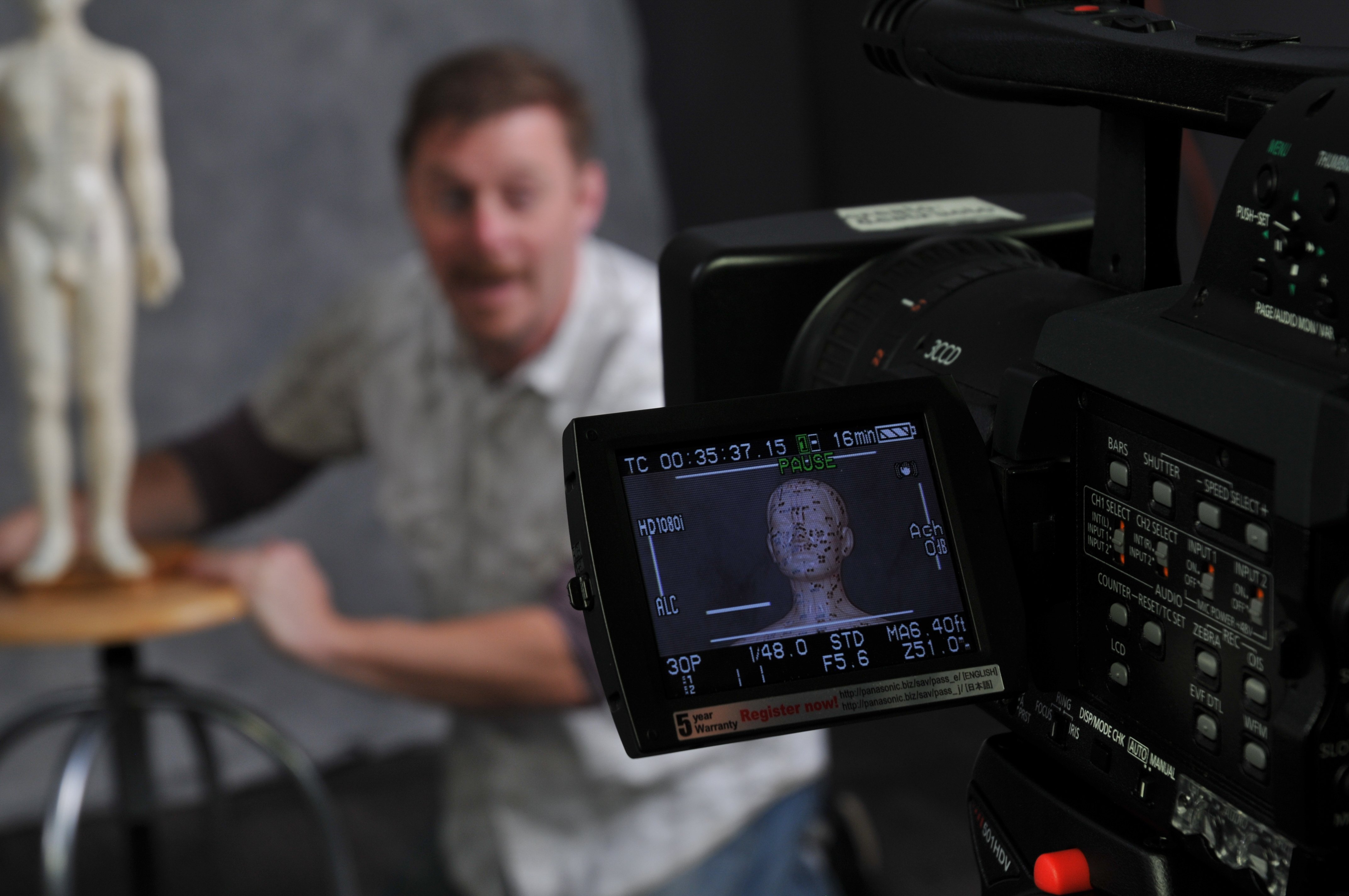
Had a new studio shoot this week — as in, a new studio space and a new project.
The clients didn’t have a huge budget, but recognized the need for video, and they were willing to move around some priorities to make sure this was done in high definition.
I’m amazed that some groups still ask for or even REQUIRE 480-based origination video. There are a lot of ways to shoot in HD as your source and downconvert from there if necessary. Even if you need a final 4:3 product. Even if this is “just for the web”. Even if you’re not sure how the project will evolve.
If you think your project can’t be done on HD… seriously, we need to talk.
 James Hyatt