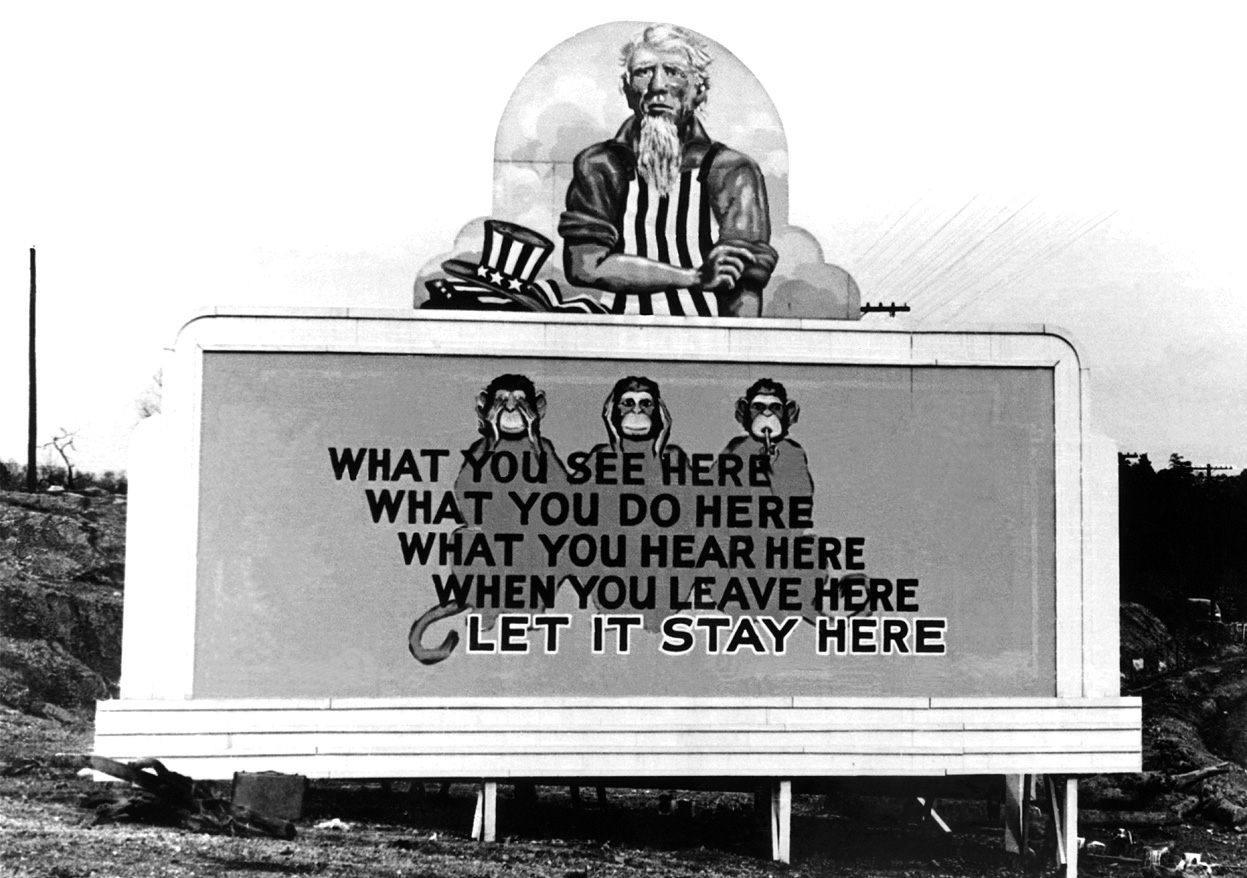
World War II "secrecy" billboard

Uranium-235: Part 1

My dad died in 1992.

He’d been ill for a while, but his death and its aftermath have remained as the most emotionally vivid, significant, and shattering experience of my life.

This is after more than two decades, after living through 9/11 in New York City, after surviving Hurricane Fran, after saying goodbye to more family members and friends than I want to think about.

I defined myself through him. I know that’s true for most young men. But from an early age (surprisingly early) I defined myself as the opposite of how I saw him. He was straightlaced, sober (never smoked or drank), law and order (literally a federal agent), and truly, deeply religious.

Of course I because the rebel, bending and breaking the law, living on the edge (the “edge”), and authentically not believing. Or not experiencing belief as he did.

This lasted through college of course, and began to change once I began working as a journalist — specifically, an investigative reporter for a well-regarded regional newspaper.

Dad read my work, and had to consider there was more to me than the pain-in-the-ass underachiever (in his eyes — after all, who needs an English/journalism degree when there are real jobs out there?) who always wanted the last word.

I kept up my habit of calling home every week. We’d talk about the issues I was writing about; the politics, the crime, the sad human stories. These were things he also dealt with in his job, before he was forced into too-early retirement (federal agents who carry firearms usually have to retire at 55).

We found common ground. We began to see each other as men, on our own, and with similar beliefs and causes. We began to really talk to each other.

Then he was gone.

He’d been diagnosed with Chronic Lymphocytic Leukemia (CLL) a decade before that. But here’s the thing about CLL — unless you test positive for a specific marker (known as ZAP-70), it’s supposed to be chronic, treatable, survivable.

Dad didn’t indicate for ZAP-70. His CLL was treatable at the beginning. At the end, though, his leukemia mutated (a few times) and his doctors were left essentially powerless, treating symptoms and offering palliative care. When the end came, it was incredibly fast; really, a matter of hours — a stark contrast to the years he’d spend living a chronic life.

So what happened?

War. Service. History. Radiation. Time.

Setting the Stage: The Atomic Age

The first atomic bomb used in warfare — Little Boy, detonated over Hiroshima, Japan on August 6th, 1945 — was an enriched-uranium bomb developed through the Manhattan Project.

The very first man-made nuclear detonation in history, the Trinity test conducted just three weeks earlier in New Mexico, used an implosion-design plutonium device (named “The Gadget”), which was also used in the Fat Man bomb detonated over Nagasaki on August 6th.

It’s stunning to realize we as a species went from no nuclear detonations in our history to three in less than a month. (I’m not going to debate it: Little Boy and Fat Man helped conclude a war with Japan that could have gone on far longer with an even more staggering death toll.)

Back to enriched uranium. Natural uranium (fully organic!) is radioactive but isn’t usable as fissable nuclear fuel. Natural uranium primarily consists of Uranium-238 (about 99.28% by weight) and just a tiny bit of Uranium-235 (about 0.71%).

U-235 is also known as enriched uranium, and it was the material used in Little Boy.

Enriched uranium is rare in nature. (Plutonium is even rarer, practically but not quit non-existent, but that’s a different article.) Highly enriched uranium (also known as weapons-grade) is a concentration of 20% or higher U-235, and is DEFINITELY not found in nature.

Enriching U-238 to weapons-grade U-235 at industrial scale — what’s needed to produce atomic weapons — was nasty work that began in the middle of World War II.

Most of that work was done in a place called Oak Ridge National Laboratory, in Tennessee.

Oak Ridge the town was known as the Secret City, because it was built as a production site for the Manhattan Project, and by presidential proclamation was declared a military district not subject to state control.

The population grew from 3,000 in 1942 to about 75,000 in 1945.

A uranium-diffusion facility named “K-25” was built during this time, and it covered 44 acres. That’s right: 44 acres. It was the largest building in the world at the time, and was constructed in near-total secrecy, at a cost equal to about $10 billion in today’s dollars.

My father arrived in Oak Ridge in 1944.

Numbers, Sloppy Numbers, and Statistics

I admit it — I get unreasonably cranky when I see sloppy, lazy or just plain bad business/financial reporting.

It goes back to my roots as a business journalist. I spent a lot of time making sure any estimates, figures, numbers or statistics I referenced were a) correct; and b) explained in as much detail as possible for general audiences.

While general-audience business journalism has historically been full of errors, false comparisons and mistakes (usually because these reporters come from J-school, not B-school), it seems to be getting worse. Yes, I’m sure news-org consolidation and downsizing has something to do with it.

But I was hit with two typical errors recently, and I have to vent.

Error 1: Not All Dollars Are Created Equal

I’m living in California’s Central Coast area now. And not to out any local media groups, but there was recent reporting on a reservoir’s water supply. So far, so good. Water’s always in the news here.

The local reporter took it a step further though, and said this particular project was built in 1957 for $5 million — what a deal that was! …And they left it at that.

Okay, if you’d going to reference past dollar figures, BRING THEM TO CURRENT VALUE! Annual inflation is a real thing, so give your audience an apples-to-apples comparison.

It’s easy. Heck, the US Bureau of Labor Statistics has an online inflation calculator.

Spending about 6 seconds there shows us $5 million in 1957 is equivalent to about $41.5 million today. Still probably a deal for a water reservoir, but now at least there’s a valid basis for comparison.

Error 2: Statistics are Slippery Things

For this next example, I’ll name names because they’re national and they should be able to take criticism. It’s NPR.

First, they were covering a sad, even tragic, topic: suicide. The reporting focused on Japan’s suicide culture, and how suicide is often seen an an honorable way out of dishonorable actions or circumstances.

Realize that I have great empathy for the issue of suicide. I don’t want to be perceived as being insensitive.

However, the reporter led with the statement: “Japan’s suicide rate is twice that of the United States. More than 30,000 people a year kill themselves in Japan.”

If I’m a casual listener, I might have missed the fact they just compared an apple to an orange. Someone could infer the US has about 15,000 suicides annually, since that’s half the Japanese number just mentioned (or another way: 30,000 is twice as large as 15,000).

But the RATE is different from the total NUMBER — especially in a country as large as the US (about 316 million people), versus Japan (about 128 million people).

This type of reporting opens the door for that same casual listener to conclude (incorrectly) if the US is only looking at about 15,000 to 16,000 suicides a year, the problem isn’t so bad.

The real numbers are far more disturbing for Americans. Yes, Japan tragically recorded about 30,000 suicide deaths annually… but the US reported 38,364 such deaths in 2010.

And there’s evidence the US rate is actually far higher, but under-reported by local authorities for a wide variety of reasons, including family concerns.

To close the loop, the rate is measured per 100,000 people — and according to World Health Organization estimates, Japan is actually not quite double the US suicide rate (21.7 suicides per 100,000 people versus 12 suicides per 100,000… and climbing for the US).

Even more depressingly, Greenland, South Korea and Lithuania have truly horrifying rates (but that’s a separate story).

Again, it’s a sad topic, but this also means there’s even more reason to make sure your figures and statistics are carefully vetted and put into proper context.

In doing the basic research for these numbers, there’s still validity to the story about Japan’s cultural view of this type of death, and the fledgling movement to change attitudes.

But another, larger story about America’s rarely discussed suicide culture is still waiting for a national stage, a national dialogue, a national discussion.

That’s just one reason why facts, figures and statistics are incredibly important to get right.

Writing for the Web: A Brief

I’ve trained hundreds of people to write effectively for the web. And I read a lot on the web — the good and the bad.  As this year wraps up, I’ve concluded good web writing isn’t a common skill.

Because  we;re in the holiday giving season, here are a handful of free tips, hints, and pointers. (The next session will be a charge…)

The fundamental truth:

• People don’t read online. They scan online. Your site visitors survey the page layout. They read down the middle. If they don’t find what they’re looking for, quickly, they move off your site.

Corollaries to the truth:

• Be direct. Be powerful. State your point. Don’t hold back the punch line.

• Make copy “scannable.” Use bulleted lists, hyperlinks, and subheaders to boost readability for basic page content.

• Use short paragraphs. Short paragraphs are scannable. Long paragraphs aren’t. If you burden visitors with long paragraphs, you’ll lose them.

• Use subheads, section titles, and anchors for longer content pages. If you have to pour a lot of information on a single page, create anchor links so readers can go to the relevant section. (Example: every FAQ page you’ve ever read.)

• “Phrase” hyperlinks. That means avoid linking to your favorite blog. Do link to your favorite blog, The Huffington Post.  It’s easier to spot a linked phrase than a single word.

• Avoid Web clichés. I still see this one: “Click here to find out more!” Why? Embed the hyperlink in text. People know what it is.

• Use the serial comma before the “and.” This slows down the reader and gets their attention.

Now go, and bore no more.

A New Arena, and Huffington Post

Yes, my posts have been few and far between as of late.

I’ve been working on final edits to a screenplay written with my partner, Devon Moore. And as the creative team behind Ninth and James Productions, I think I can speak for both of us and say the time away from the story has helped tremendously. The story now barrels down the road like a supercharged hot rod…

In other news, I’ve been working with UBIMS Inc. and founders Luke Ho-Hyung Lee and Jess Parmer. Luke and Jess have an innovative, if not revolutionary, if not actually evolutionary idea that could transform industries and economies around the world.

Our first article, describing the fundamental and essentially hidden problem confronting any economic recovery, is up on The Huffington Post.

Give it a read, let us know what you think:

After the Election: The Hidden Flaw Holding Back Full Recovery

– James

Before Katniss; Other Teen Dystopia

Yes, The Hunger Games is a box-office phenomenon, and good for them!

The film’s creative team did a good job translating the book to screen (and yes, I know there are some detractors out there, but screw ’em. A film is it’s own separate work of art and has its own needs and requirements). The producers also did a fantastic  job keeping the budget down and production values high. Who can’t appreciate a film that can succeed artistically and financially, right?

But this isn’t the first teen-dystopia film. Not by a long shot. A really quick, top-of-my-head review would include Lindsay Anderson’s “If… with an incredibly young Malcolm McDowell; Michael Anderson’s “Logan’s Run with Michael York; and Stanley Kubrick’s “A Clockwork Orange, with a not-as-young Malcolm McDowell. I could go on and mention Peter Brooks’ “Lord of the Flies, and even “Children of the Corn,” but we’re getting younger and younger with these films. (And, with that last mention, crappier and crappier.)

The film I’m REALLY here to talk about is arguably the best teen-dystopia film ever made. You’ve probably never seen it, possibly never heard of it, and that’s a crying shame. It’s a disturbing, exciting and even hilarious work of genius by one of Japan’s premier directors, and he regarded it as his warning cry to younger generations.

That film is Battle Royale” by Kinji Fukasaku. It came out in 2000, never got a real US release, but it will knock you on your ass. It’s been release on Blu-Ray recently, although you can also find regular DVD versions. The story takes place in a near-future totalitarian Japan that keeps its population in line and entertained by a yearly battle to the death of an entire randomly-selected school class. The set up takes place in just minutes, and the students literally have to come out of the room fighting. Beyond that, it’s a gigantic bloody game of hide-and-seek among the adolescent characters.

I first saw the film on DVD, with my nephew. We had no idea what to expect, and our jaws dropped in awe, terror and admiration as the movie played out. At the end, he turned to me and said, “That was the best movie EVER!”, so we promptly turned around and screened it again. It’s that damn good.

Even though the film won several awards and was the buzz on the festival circuit, word was an American release wasn’t possible so soon after the 1999 Columbine massacre. It looks like an American version is in development, but that’s been a rumor with different production houses for years now.

Do yourself a favor and check out the original, on Blu-ray or regular DVD. Keep in mind this film ISN’T for young children, and it’s in Japanese with subtitles. Oh, and under no circumstances should you check out the sequel. The director died while production was under way, and the film was completed by his son. It’s not good; really not good at all.  Trust me on this.

All that said, I can’t recommend “Battle Royale” highly enough. Here’s the trailer:

Just a quick “Drive”…

I know, I know. It’s been a long time between posts.

My excuse is I moved all the way across the continent to start a film production company with my amazing partner, Devon Moore.

More on that later.

But here’s the clip, with comments below:


If you haven’t seen this film, and it’s still at your local theater, go see it ASAP.

It stars Ryan Gosling as essentially an updated “Man With No Name” character — he’s variously referenced as “the driver,” “the kid,” etc. Gosling plays a stunt driver, mechanic, and freelance wheel man for whatever job you’re willing to pay him for: legal or not.

The film has two pedigrees.

First, it’s based on the novel by James Sallis (although the screenplay’s by Hossein Amini).

Second, it’s directed by Nicolas Winding Refn, best known for his “Pusher” crime drama series, as well as “Bronson” and “Valhalla Rising”.

Sure, he’s Danish, but don’t think cerebral and soft — Winding Refn knows how to direct some violent action.

With that said, don’t expect a LOT of high-speed car chases. There’s some four-wheel adreneline, but most of the action is violence outside and on foot — between people who are desperate and willing to kill to get what they want.

It’s also a real change of pace for Gosling. If you remember him from “The Notebook,” this movie should completely blow up that little romantic bon-bon. There’s a lot of intense, explicit violence, and his character works right on the edge of extremes.

And although it’s set in contemporary Los Angeles, that’s really just a setting.

This isn’t an American crime drama as such — it’s an artful take on “American” crime dramas of the past, drawing from a clear European sensibility.

But don’t take my word for it. Go see it if you can, and if it’s left your local theater, check it out on DVD or your preferred streaming provider.

Sundance 2011: Documentary Roundup

First, a clip, then some comments:

The above is a backgrounder for the “Hot Coffee” documentary, more on it later.

And yes, I’m behind in terms of Sundance 2011 updates and coverage. I was surprised by some Internet access issues, but I also should have taken into account the weird day-to-day schedules that are the Sundance Film Festival.

At least I didn’t have to deal with intimate strangers in my condo, as did this journalist.

(Most of) The Winners

Documentaries are the hidden gem of the Sundance Film Festival. Sure, you get the occasional breakout hit such as “Supersize Me” or “Bowling for Columbine” — but there are a lot of other great documentaries that essentially go on to possible but unlikely theatrical distribution ; with most relegated to PBS, cable or online.

That’s a shame. The documentary programs (U.S. and World Cinema) essentially match the structure of Sundance’s feature film organization: films in competition, films that are premiers but not in competition, then other slots for those that are hard to peg or need some additional support (such as Spotlight, NEXT, Park City at Midnight, depending on the year and selections).

And it’s a shame these docs don’t get their fair share of attention. They’re generally of a far higher quality than the features, and they don’t suffer from the same tension of art-vs-commerce in terms of featuring celebrity/name actors versus just great acting talent that the fictional pieces have to balance.

Yak yak yak. Here’s a short list of docs that won awards at the 2011 festival, so they’ll likely be distributed in some form, this year:

How To Die in Oregon, directed by Peter D. Richardson. This won the Grand Jury Prize. It’s a study of how that state’s assisted-suicide rules affect the lives of terminally ill patients, their families, and the physicians involved. Gripping, ultimately affirming.

Hell and Back Again, directed by Danfung Dennis. This is a joint U.S./United Kingdom production, and won both the World Cinema Grand Jury Prize and World Cinema Cinematography Award. To the point, though, it’s about the journey of North Carolina soldier Sgt. Nathan Harris, shot by the Taliban in Afghanistan. His recovery has been long and grueling, and supposedly reveals the cost we’re paying in lives lost and lives damaged in this ongoing conflict.

Buck, directed by Cindy Meehl. This won the Documentary Audience Award, and profiles the trainer that inspired “The Horse Whisperer,” Buck Brannaman.

Project Nim, directed by James Marsh. This won the World Cinema Directing Award, and is from the same team that brought us “Man on Wire”!! Nim is a chimpanzee that, beginning in the 1970s, was taught sign language in an attempt to see if we could have true cross-species communications. Things… evolve from there.

Documentaries that need some championing

(As in, they may be harder to find after Sundance).

The Green Wave, directed by Ali Samadi Ahadi. The first major documentary about the short-lived, violently-crushed democracy movement in Iran, 2009, following what likely was an election stolen from Mir Hossein Mousavi.

The iranian director combines live action and animation to tell this heartbreaking story, while also offering up hopeful possibilities for the future.

The Last Mountain, directed by Bill Haney. It’s about the practice of mountaintop coal removal, specifically in West Virginia. But If this doc is even halfway competently done, it should ring alarm bells nationwide in terms of the short- and long-term damage this practice does to the environment, the community and the local and regional economies.

Hot Coffee,  directed by Susan Saladoff. It’s about the McDonald’s hot-coffee lawsuit, but DON’T roll your eyes. It tells the story after the story you think you know. McDonald’s and other large corporations have used this case as an example of how tort law needs to be reformed — but it’s a slick spin job on their part. Hearing how average citizens have tried to get their cases to trail could make this a crowd-pleaser.

Probably coming to your town or television…

Documentaries that, while still good, probably have a great shot at widespread distribution —

Miss Representation, directed by Jennifer Siebel Newsom. This focuses on how women are portrayed in the media, and in our culture at large. It features interviews with Katie Couric, Condoleeza Rice, Nancy Pelosi, Gloria Steinem and Rachel Maddow, to name just a few. Trust me, you’ll get a chance to see this one.

Page One: A Year Inside ‘The New York Times’, directed by Andrew Rossi. A fascinating account of how arguably the world’s best newspaper is dealing with the change from print to online — but not just in terms of delivery modes, ad charges, and balance sheets. What happens if The Paper of Record loses the economic and cultural battle, and we lose one of the great investigative reporting resources the nation has ever known. Is a replacement model even possibly in this day and age? Are essentially unedited/lightly curated online resources such as Wikileaks even near what the NYT brings to the table?

One way or the other, this will get some form of distribution.

Troubadors, directed by Morgan Neville. The story centers on James Taylor and Carole King to discuss the larger story of 1970s Los Angeles-based singer/songwriters. Could be just great, likely will get distribution, but other docs deserve more championing.

Sundance 2011: Day 5, the YouTube Connection

First, a couple clips, then some stories:

But I concede that — apart from Virginia being impossibly cute, adorable and brave — this teaser doesn’t say much about the “Life in a Day” feature. Let’s try one more:

As mentioned earlier, if you live in Ann Arbor, MI; Brookline, MA; Brooklyn; Chicago; Los Angeles; Madison, WI; Nashville; San Francisco or Seattle — you can attend a special local screening of a Sundance 2011 film.

For the rest of us, YouTube will make it possible to collectively share the world premier of the “Life in a Day” documentary as it’s screened in Park City, Utah.

All you need to do is go here, by 8pm ET, 7pm CT, 5pm PT on Thursday, Jan. 27http://www.youtube.com/user/lifeinaday

Following the screening there will also be a live Q&A with the documentary’s director, Kevin MacDonald, along with a small group of specially-invited contributors to “Live in a Day”. (Impressive stats: this project drew more than 80,000 clips, and uses 1,125 of them. I’m sure the project probably shortened the lives of about 10 editors…)

Note, though, that the film WON’T be freely available on YouTube after that (it still has a theatrical run coming up this year), although you’ll be able to see a re-broadcast 7pm on Friday, January 28, in your local time zone.

But Sundance and YouTube have worked out something else that can keep you captivated through the rest of the long winter months.

Check out The YouTube Screening Room, which is showing a total of 12 shorts from Sundance 2011, plus four “career-starting” shorts from past festivals (!), and four shorts from the Sundance Directors Lab* (*no guarantee these won’t suck…). And they’ll add more on January 27 and February 3.

Meanwhile, here’s a loving tribute to 8-bit video game heros:

Want something a little more significant from your short films?

Okay, fine, check out skaters in Kabul!

Tomorrow, on the ground in Park City.

And the Best Mockumentary of 2010 is…

First, the clip, then the story:

You might have already seen “Exit Through the Gift Shop”, the film by famed street artist/social provacateur Banksy.

For a film placed in the documentary category, it’s done well at the box office: nearly $5 million worldwide so far, which places it in the Top 40 gross of all documentaries released theatrically. (Trivia: “Farenheit 9/11”, “March of the Penguins” and “Earth” are the top performing docs. I knew you’d wonder…)

I got on the “Exit” tangent because I mentioned to a friend recently that I’d hoped to be blown away by “The Philosopher Kings” — but wasn’t.

They followed with “Hey, you know what’s a great documentary? ‘Exit Through the Gift Shop’. That was a great documentary.”

After I stopped pulling out my hair, I mustered a “You really thought that was a straight-up doc?”, and got just a quizzical look in return.

— Don’t get me wrong. If you haven’t seen this film, definitely check it out. It’s incredibly entertaining. But while the filmmakers themselves will be loathe to ever tell the whole and full story about how it was made, I’ll bet everything in my 401(k) that it ain’t what many believe it to be: a real documentary.

It IS a fascinating look at the history of street art (think Banksy, of course, but also Shepard Fairey, Space Invader and Zevs, to name a few); Andy Warhol and his continued influence on contemporary art and contemporary society; and then, essentially a one-sided pissing match between the street-art community and contemporary, famous and well-paid “established” artists. Guess who comes out on top?

Oh, and this fight is cleverly wrapped inside another “fight” between alleged original director
“Thierry Guetta” and Banksy himself — who claims he had to take the project over because of “Guetta’s” incompetence as a filmmaker. Incompetence like this, which I challenge you to match yourselves:

Anyway, Banksy says you can, at home, in a couple hours or so. and that’s why he took over the project.

But let’s move on to the REAL controversy.

— Will “Exit Through the Gift Shop” get nominated in the Best Documentary category at this year’s Oscars? (It’s on the short list of 15 docs, although only 5 will make the final selection…)

— If it does, is that like Milli Vanilli getting nominated for and winning a Grammy? Okay, assume Fab Morvan and Rob Pilatus actually were self-aware and in control of their careers, if you wanted to make it a better comparison.

— What if it actually wins the Oscar for Best Doc? (“Waiting for ‘Superman'” will take it, although “Client 9: The Rise and Fall of Eliot Spencer”, “Inside Job” and “Restrepro” are better, but far more political and therefore problematic.)

Oh, and just so you know, “Exit” was nominated for the 2010 International Documentary Association’s “Distinguished Feature” award (it lost to “Waste Land”), and is also up for the “Independent Spirit Award” sponsored by IFC.

It could win (the event is Feb. 26), but if I were Banksy, I’d keep a wide berth from Sebastian Junger if “Restrepro” loses to him. Something about all that time spent at a forward operation base in Afghanistan, real bullets, real death, etc…

On being on the road

Which is worse? Okay, maybe “worse” implies something truly horrible.

How about — which, to you, would be harder to deal with?

After a long day of working on the road, coming back to:

1. A small, empty hotel room; or

2. A large, empty hotel room.

After a couple straight days, I think the large (but empty) hotel room is worse for me, personally.

All that space reminds me of what (or more precisely, whom) isn’t there.

A small room just means my stuff can fill up a lot of that space.

With a big room, there are expanses and echoes and a lot more empty.

But this will pass. And so will these mid-winter traveling blues.

– James